Build AI workflows visually
AI-Flow is a visual platform for combining AI models, data, media, and external services into complete workflows. Instead of moving results manually between separate tools, you connect reusable nodes and let data travel through the graph.
The same workflow can serve several purposes: edit it on the canvas, run it through a focused App interface, reuse it inside another flow, or expose it through an API.
Launch AI-Flow · Follow the 5-minute guide
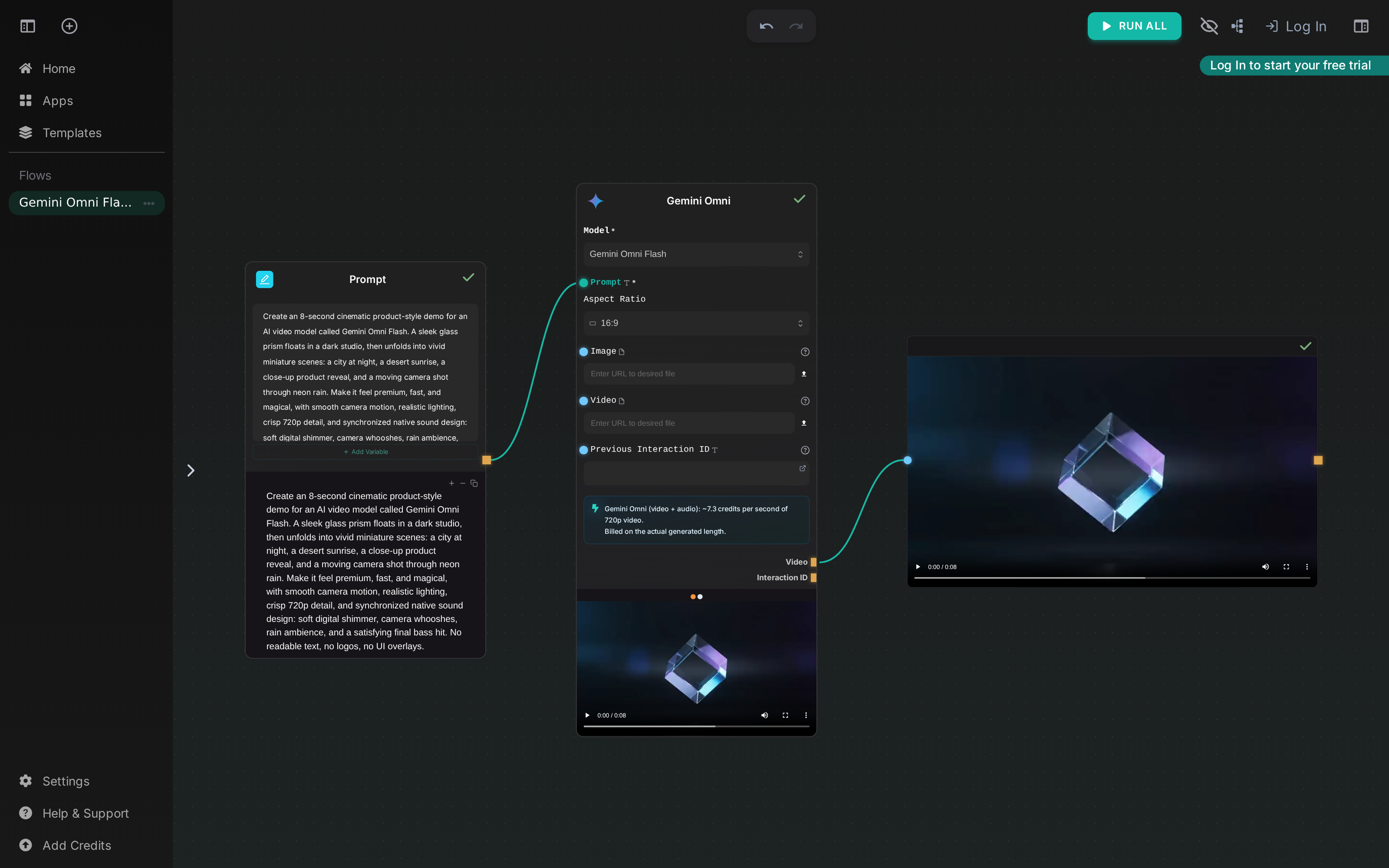
One workflow, several ways to use it
| Experience | Best for |
|---|---|
| Visual canvas | Building, inspecting, and customizing the complete workflow graph |
| Apps | Running a workflow from a simple form without opening the editor |
| Subflows | Reusing a tested workflow as one node inside a larger automation |
| API Builder | Calling a workflow from your product, backend, or automation platform |
You do not have to choose permanently. A workflow that starts as a template can later become an App, a subflow, or an API endpoint without rebuilding its core logic.
What can you build?
AI-Flow supports workflows that mix text, images, audio, video, documents, structured data, and web services. Common examples include:
- Content pipelines — research a topic, generate structured copy, create media, and prepare the result for publication.
- Image and video production — generate, edit, upscale, animate, or chain several specialist models together.
- Document and web processing — extract text, summarize sources, transform JSON, and route results based on conditions.
- Business automation — process Airtable or Notion records, call external APIs, and send results to another service.
- Product features — turn a workflow into a REST API or a focused App for repeated use.
AI-Flow brings providers such as OpenAI, Google Gemini, Anthropic, Replicate, fal.ai, Stability AI, ElevenLabs, and others into the same canvas. Browse the Node Reference for the current catalog.
How a flow works
A flow is a directed graph. Each node performs one job: accept input, call a model, transform data, control execution, integrate with a service, or present an output.
- Add nodes from the node library or begin with a template.
- Connect an output handle to a compatible input handle.
- Configure prompts, files, model settings, or other fields.
- Run one node while testing, or use Run All for the complete graph.
- Reuse the result downstream, expose it as a Flow Output, or continue with an Instant Action.
Connections replace manual copy-and-paste: the output of one step becomes the input of the next. Branches, conditions, loops, and subflows let the graph grow without turning every use case into one large workflow.
Learn the editor fundamentals in How Nodes Work.
Start at the right level
| Your goal | Recommended starting point |
|---|---|
| Get a result with minimal setup | Open a ready-made App |
| Learn from or customize an existing workflow | Browse Templates |
| Design a workflow from scratch | Create a blank flow, then read How Nodes Work |
| Add a workflow to your application | Start with API Builder |
| Compose larger automations | Use Subflows and Loops |
The Getting Started (5 min) guide walks through an App, a template, the canvas, execution, and the most useful advanced concepts.
Credits and your own API keys
Supported nodes can run with AI-Flow platform credits, so you can begin without configuring several provider accounts. If you already have provider access, connect your keys from Settings → Secure Store. Compatible nodes then bill model usage through your provider account.
Both approaches can coexist in the same workflow. See Bring Your Own Keys for supported providers, storage controls, and billing details.
Go further
- Define clean workflow interfaces with Flow Input and Flow Output nodes.
- Turn results into follow-up workflows with Instant Actions.
- Call third-party services or send webhooks with the HTTP Request node.
- Reuse complete workflows with Subflows.
- Ship a workflow behind a REST endpoint with API Builder.